
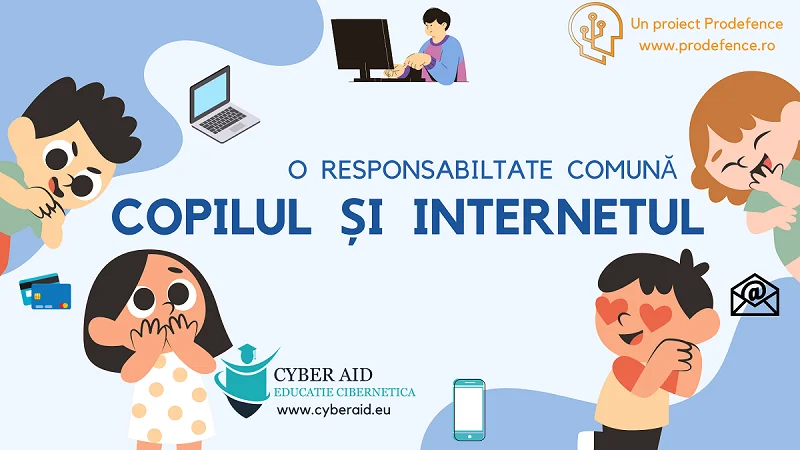
Children grow up in a world that is connected by default. That is not a problem in itself: the internet is where they learn, play and keep their friendships. The problem is that the more time a child spends online, the more likely it becomes that they meet something they are not equipped to handle, and that the adults around them never find out.
This is the first material in a series written for parents and teachers. It sets out what cyber education for children actually means, what the main risks look like from the child’s side, and what can be done about them without turning the house into a surveillance operation.
What cyber education for children means
It is not a lecture about danger. It is a small set of habits, learned early and reinforced as the technology changes. In practice it means a child knows:
- what counts as personal information and why it is worth protecting;
- that a stranger online is still a stranger, however friendly the conversation;
- how to spot an obvious fraud or a fake message;
- what harassment looks like, and that reporting it is not telling tales;
- that not everything worth copying online is worth copying;
- how a malicious app reaches a phone in the first place.
It can start early and it does not finish. Platforms change, and so do the ways people are targeted on them.
One point matters more than any list. The risks are real, but what follows from them is usually invisible to the people around the child. A conversation that went wrong, a photo that was shared, a threat received in a private message: none of it shows on the screen the parent walks past. The effect on the child, however, can be considerable.
What children actually meet
- Cybercriminals. People who use technology to commit crimes: identity theft, online fraud, unauthorised access to personal data. Children are reached through games, social networks and messaging, often with an approach that looks like nothing more than a friendly message.
- Adults seeking sexual contact. Grooming begins as ordinary conversation and moves gradually. A child who has been told what that progression looks like recognises it far earlier than a child who has only been told to be careful.
- Online harassment. Offensive messages, coordinated comments, an embarrassing photo passed around. It reaches into the home, it does not stop at the school gate, and its effects on mental health are well documented: anxiety, depression, withdrawal.
- Unsuitable content. Violence, pornography and hate speech are a search result away, and children usually meet them by accident rather than by looking.
- Imitation and bad influence. Children are drawn into groups and to behaviour that promises approval. The validation is real to them even when the audience is not.
- Dependence on the device. Time online displaces sleep, movement and unstructured attention. This one is rarely dramatic, which is why it is usually noticed last.
The signs an adult can actually see
When something has gone wrong, the change is usually in behaviour rather than in the device. The child becomes secretive, keeps the screen turned away, locks the phone where it used to lie open, or reacts sharply to an ordinary question about it. Online activity may increase suddenly, or stop just as suddenly. None of these on its own proves anything. Together, and out of character, they are worth a calm conversation.
What parents and schools can do
- Teach the basic rules of using the internet, and keep teaching them as the child’s use changes.
- Use content filters to block access to material that is clearly unsuitable for the age.
- Know which platforms the child uses and who they talk to there, in a way the child knows about.
- Make reporting easy. A child who expects to lose the device for admitting a problem will not admit the problem.
- Keep devices in shared space where that is practical, and treat what happens online as an ordinary subject of family conversation rather than an interrogation.
- Explain passwords and personal data early, in terms of what they open rather than in terms of rules.
Where the responsibility sits
Cyber education is not something that can be delegated to the school, to the platform or to the child. Parents set the habits, schools give them structure and repetition, and the adults involved need enough understanding of the environment to be useful when something happens.
The internet remains a good place for children to learn and to be social. Saying so is not naivety: the alternative, treating every device as a threat, produces children who hide what they do rather than children who are safe. What works is the ordinary thing. Explain the risks, agree on the limits, and make it clear that telling an adult about a problem online will never make the problem worse.
The rest of the series
Materials for parents and teachers. They can be read in any order.
- How social media platforms work, and what they are for
- Using social media responsibly: habits worth building early
- The effect on mental health
- Unsuitable content and disinformation
- Privacy and security, once given away
- AI-generated visual content and its effect on children
- The first signs that something is wrong online
- Monitoring a child’s online activity, without turning it into surveillance