
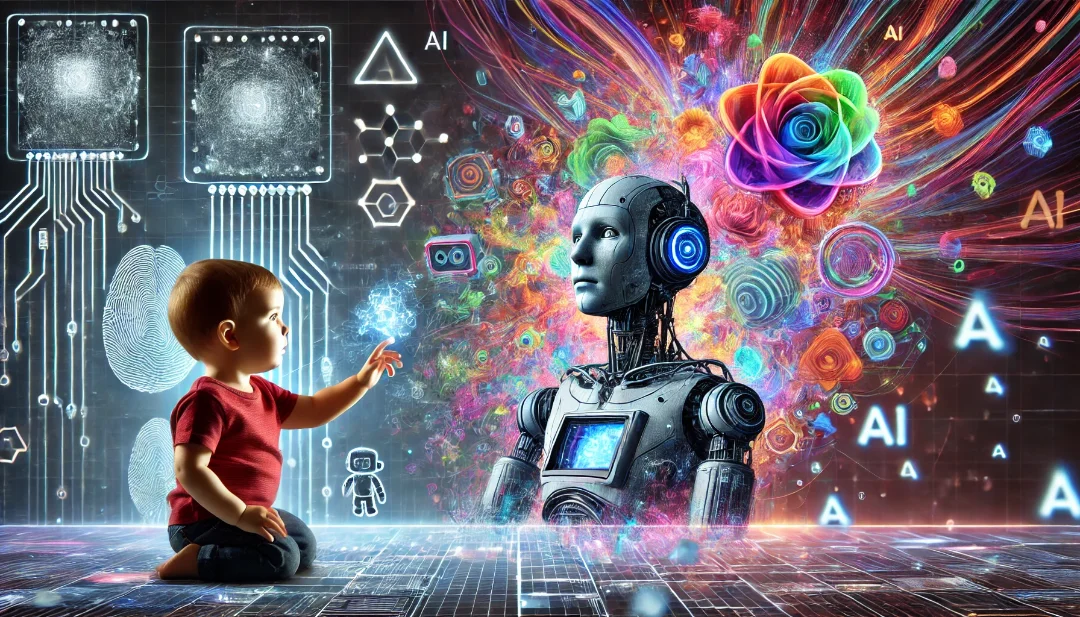
Children see an enormous quantity of images and video every day. What has changed is that a growing share of it was never photographed. It was generated, or altered, well enough that adults cannot reliably tell, which means children certainly cannot.
The risk is not any single fake. It is what a continuous stream of realistic, invented material does to a person who is still forming a sense of what is normal, what is achievable and what is true.
What this content actually is
Images and video produced by algorithms that can reproduce faces, voices and situations that never existed. Deepfake is the best-known form: neural networks replace a face in a video, or create one outright. The same techniques can change a person’s expression, or synthesise a voice closely enough to pass.
Plenty of this is harmless and some of it is genuinely useful, in education and in entertainment. The same tools are also used for blackmail, harassment and political manipulation, and the technical barrier to using them has effectively disappeared.
The specific risks for children
- Believing what is false. A convincing image is treated as evidence. This is how conspiracy material spreads, and children have fewer reference points to weigh it against.
- Emotional manipulation. Synthetic content is used to push messages, to normalise a toxic position, or to encourage risky behaviour, packaged as entertainment.
- Harassment with fabricated material. Images and video of a real child, made from nothing and distributed. There is no defence available to the child, because the material is invented and denying it looks like a defence.
- Unsuitable material. Generative tools produce violent and sexual imagery on demand, outside the moderation systems that governed older sources of it.
- The effect on mental health. Constant exposure to invented perfection, in bodies, in lives, in outcomes, produces exactly the comparison problem that ordinary social media produces, at a higher intensity, because there is no real person at the other end to fall short of it.
What parents can do
No filter solves this on its own, and the technology is moving faster than the tools built to detect it. What works is judgement, taught early.
- Say plainly that not everything seen is real, and make checking a source an ordinary habit rather than a special procedure.
- Use the parental controls that platforms and devices provide, understanding that they reduce accidental exposure rather than eliminate it.
- Keep the conversation open. A child needs to know they can bring you something that frightened or confused them without consequence.
- Set the example. Check things before sharing them. Children copy what adults do with a suspicious message, not what adults say about it.
- Teach reporting. Flagging false or harmful content on a platform is something a child can actually do, and it builds a sense of responsibility rather than helplessness.
- Keep some of the day offline. Sport, reading, anything with a natural end to it. Time away from screens is the simplest correction to a distorted picture of the world.
- Talk to the school and to other parents. This is not a problem a single household solves alone.
The aim is not a child who distrusts everything. It is a child who knows that an image is a claim, and that a claim can be checked.
The rest of the series
Materials for parents and teachers. They can be read in any order.
- A shared responsibility: what cyber education for children means
- How social media platforms work, and what they are for
- Using social media responsibly: habits worth building early
- The effect on mental health
- Unsuitable content and disinformation
- Privacy and security, once given away
- The first signs that something is wrong online
- Monitoring a child’s online activity, without turning it into surveillance