
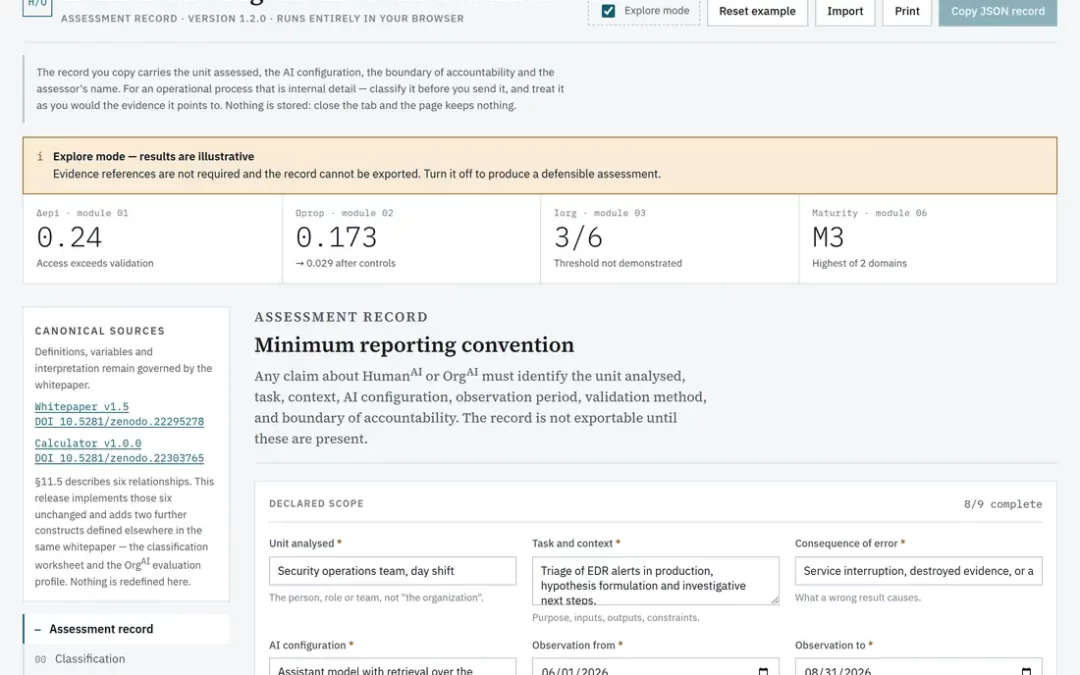
Version 1.2.0 of the Humanᴬᴵ and Orgᴬᴵ Framework Calculator is publicly available, free of charge. It is a single HTML file that runs entirely in the browser: no installation, no account, and no network request of any kind. It opens unchanged on a machine with no internet connection.
The instrument accompanies the whitepaper “Humanᴬᴵ and Orgᴬᴵ: A Relational Framework for AI-Mediated Human and Organizational Capacity”, and turns the relationships defined there into an assessment record you complete for a concrete situation: one process, one team, one observation period.
The problem it addresses
Every organization that has introduced AI into a process eventually faces the same question: does it work?
The usual answer rests on two observations: people are visibly faster, and nobody has complained. Both may be true. Neither answers the question.
The difficulty is that “does it work” conflates things that must be measured separately: what the system can produce, what the accountable person can validate, who is authorized to decide, and what happens to a wrong conclusion once it enters the workflow. The framework separates them. The calculator makes them computable.
The central distinction is epistemic decoupling: the gap between the range of answers AI makes accessible and the demonstrated capacity of the accountable actor to validate them. When access grows faster than validation, an organization produces claims it cannot support, and then reuses them.
What it looks like
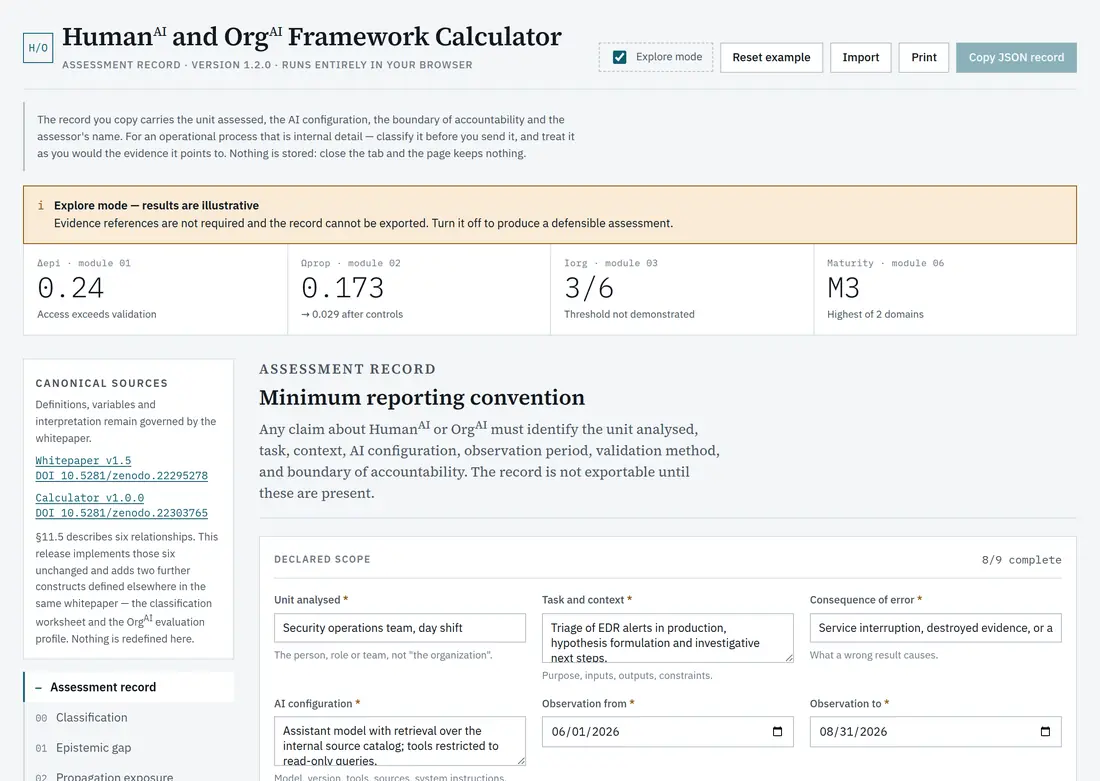
Eight modules and a diagnostic panel. The modules are a sequence rather than a menu: module 02 consumes the result of 01, module 06 depends on 03, and the classification worksheet can stop everything else if the situation does not belong to the construct.
| Module | What it establishes |
|---|---|
| 00 · Classification | Whether the situation is a Humanᴬᴵ case, through a ten-question membership test |
| 01 · Epistemic decoupling | The gap between access and validation, with a confidence interval |
| 02 · Propagation exposure | How an unvalidated error is amplified by reuse, now and after declared controls |
| 03 · Orgᴬᴵ threshold | Whether the six constitutive conditions are demonstrated or merely declared |
| 04 · Contribution profile | On which dimensions AI changes the outcome, in which direction, and what is lost |
| 05 · Synergy test | Whether the result exceeds the relevant comparators with declared risk thresholds satisfied |
| 06 · Maturity | The M0–M5 level for each bounded domain separately |
| 07 · Orgᴬᴵ profile | What the organizational architecture actually produces, not merely that it exists |
What changed since version 1.0.0
This release began from an uncomfortable finding: in four places, the calculator contradicted its own whitepaper.
- Material contribution was evaluated on a single dimension chosen from a dropdown, although the whitepaper defines a seven-dimension profile and explicitly forbids compressing it into a score.
- The exported record carried none of the seven fields of the minimum reporting convention, and so was not citable under the framework’s own rule.
- Access and validation were entered as slider values, although they are proportions over a declared task set, which manufactured an apparent precision with nothing behind it.
- Validated organizational learning appeared disconnected from the architecture it belongs to.
All four are fixed. No formula defined in the whitepaper was altered, and the six assertions of the original test suite pass unchanged.
On top of the repairs, the missing constructs were added: the classification worksheet, an evidence reference for every organizational condition, propagation exposure compared before and after controls, the nine-dimension organizational profile, maturity assessed per domain, an anti-pattern detector, and a JSON schema that can be reimported.
Three things worth seeing
A profile, not a score
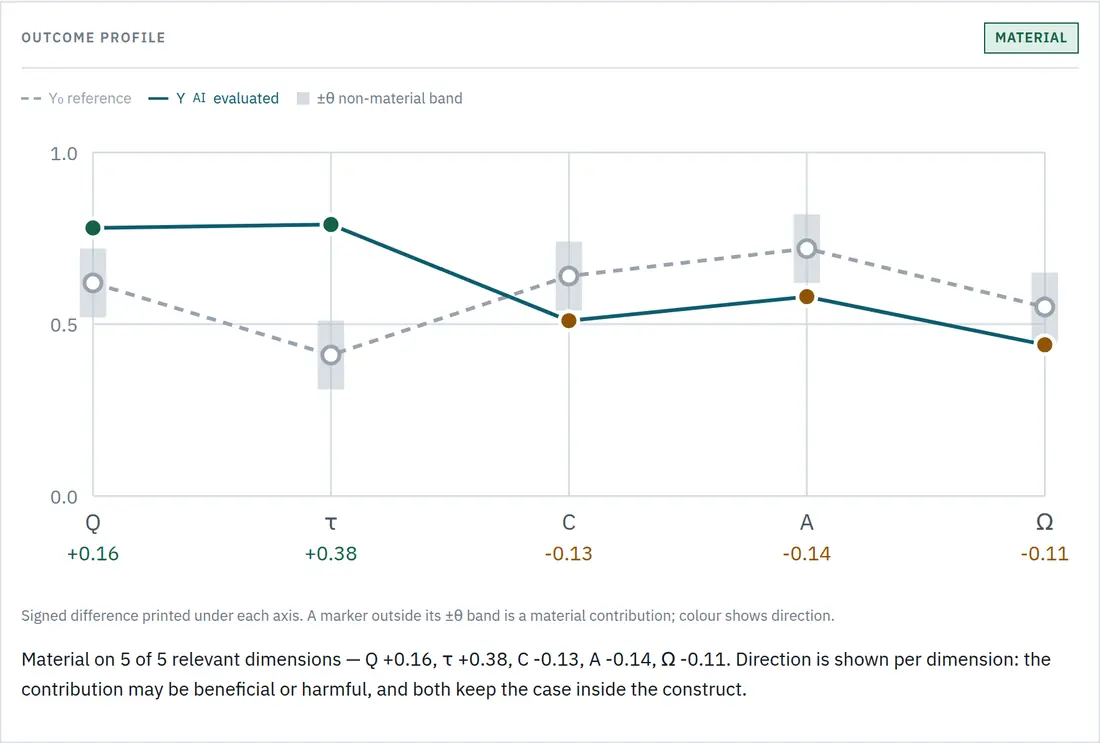
In the example above, AI made security alert triage substantially faster and moderately better. At the same time, trust calibration, analyst autonomy and risk exposure all worsened, each beyond the declared threshold.
A composite score would have summed the five values and reported a gain. That result would have been technically correct and entirely misleading: the speed had been obtained partly by reducing validation. The instrument refuses to produce that figure, not from a technical constraint, but because the whitepaper forbids compressing the profile, and a single score hides precisely the trade-off that matters.
A number without a volume says nothing
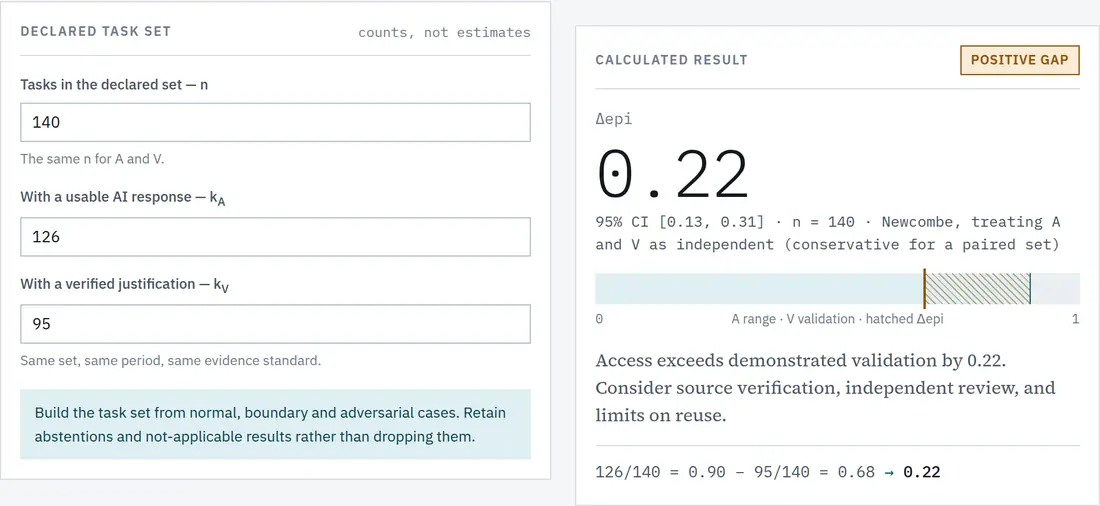
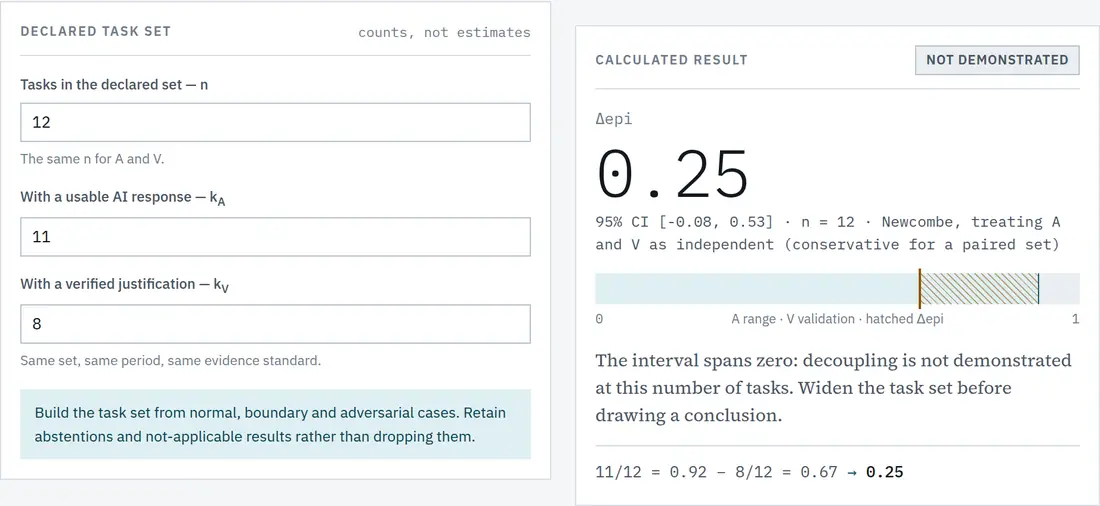
Access and validation are entered as counts, how many tasks out of how many, not as estimated percentages. Counts yield a confidence interval, and when that interval contains zero the instrument reports “not demonstrated at this number of tasks”, not “no gap”.
A larger gap, badly measured, supports less than a smaller one measured well. The instrument does not hide that difference behind the same two-decimal figure.
A claim is not evidence
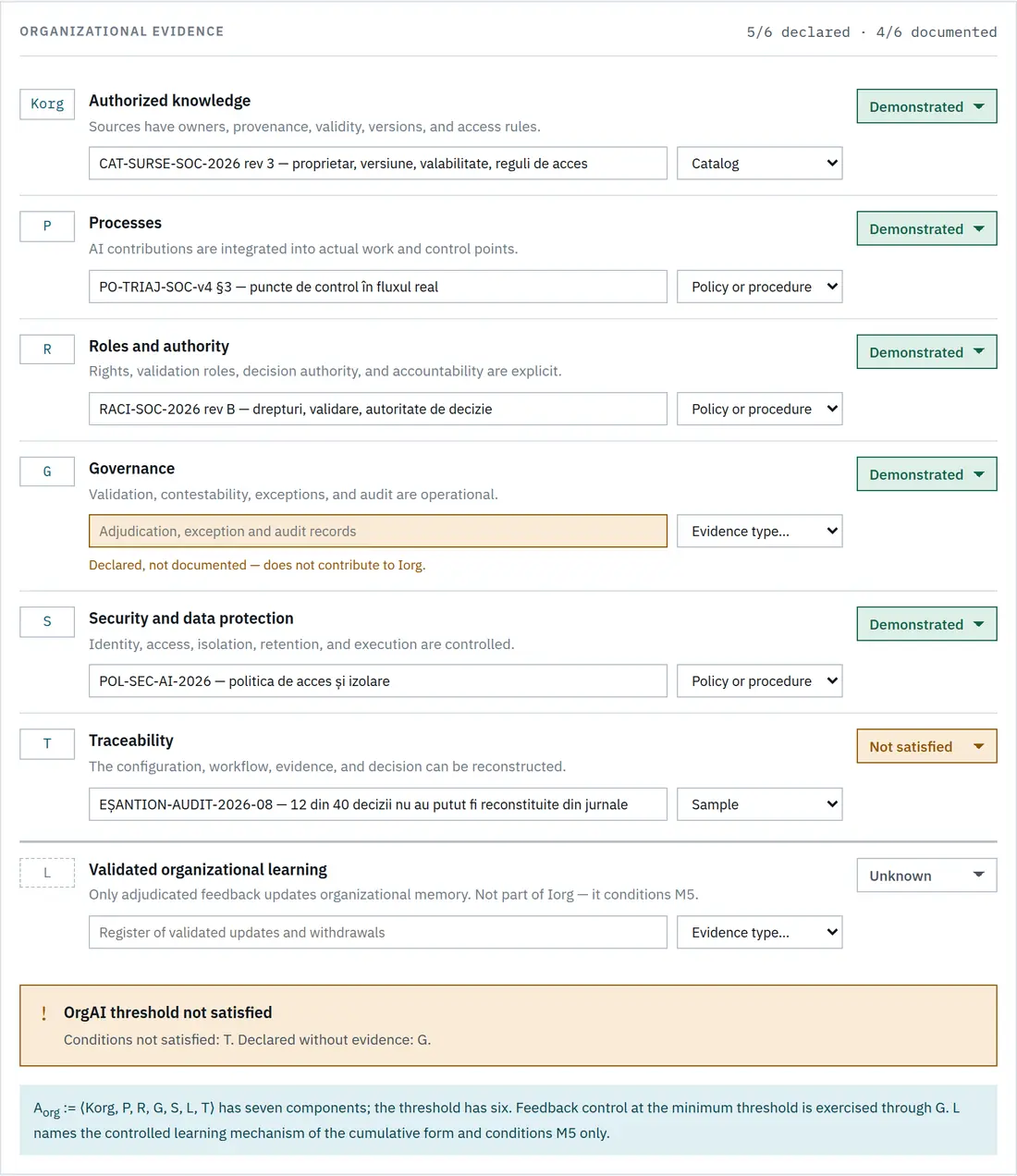
Each of the six organizational conditions requires an evidence reference and its type, not a tick. A condition marked “demonstrated” without a reference is reported as declared but undocumented, and does not count toward the threshold. The counter becomes a pair, declared and documented, and the distance between the two numbers is the distance between what an organization believes about itself and what it can show.
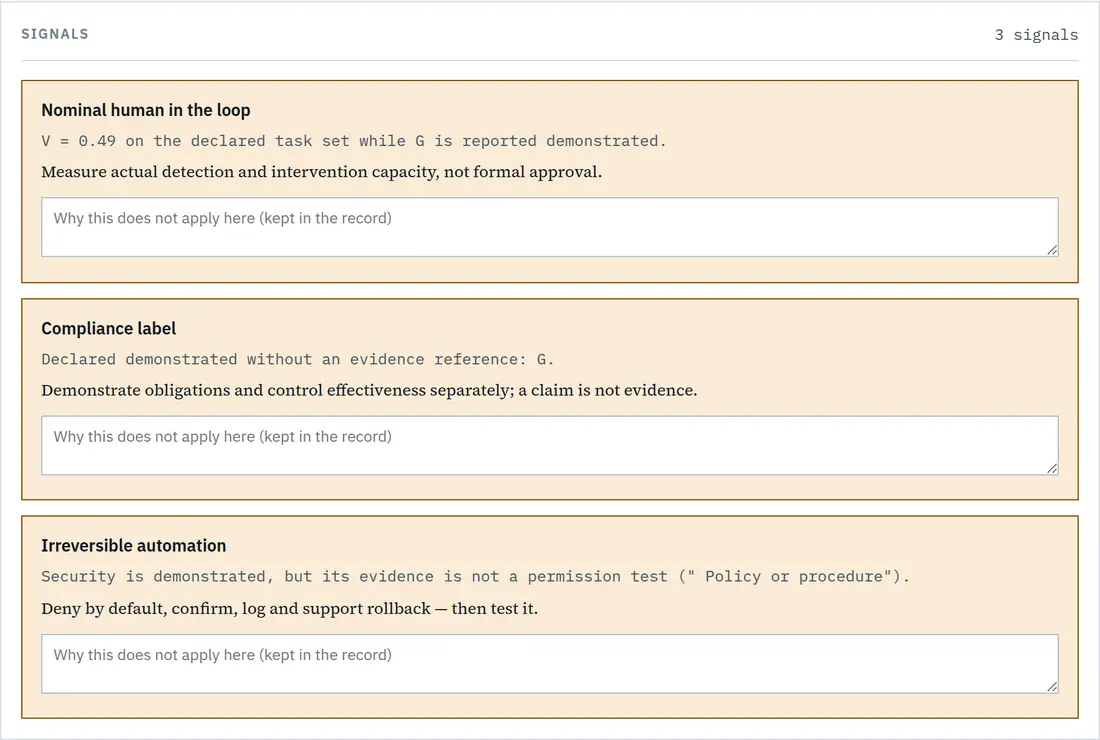
Across all modules runs a detector that reads the configuration as a whole and looks for contradictions between what was declared in one place and what was measured in another. It is the only component that tells the assessor something they did not already know on the way in.
Properties
| Property | State |
|---|---|
| Installation | None. One HTML file opened in any modern browser |
| Network requests | None. Typefaces are embedded, so it works on an isolated network |
| Browser persistence | None. No localStorage, no cookies |
| Account, database, analytics | None exist |
| Security policy | A restrictive CSP in the self-hosted build, with connect-src ‘none’ |
| Verification | 29 automated tests that extract the logic from the shipped file |
The last line deserves an explanation. The tests do not hold their own copy of the formulas: they extract them from the file that ships, between two markers in the code. A passing run is a statement about the file you are holding, not about a laboratory version.
Where to get it
- The instrument, version 1.2.0: DOI 10.5281/zenodo.22884721, zenodo.org/records/22884721;
- The instrument, all versions: DOI 10.5281/zenodo.22303765;
- The canonical whitepaper: DOI 10.5281/zenodo.22295278.
The record carries both the source archive and a ready-to-use index.html. No unzipping is required: the file opens directly in a browser.
The code is licensed MIT, © 2026 S.C. PRODEFENCE S.R.L. The conceptual framework, definitions and interpretive text remain under CC BY-ND 4.0 as published in the whitepaper. In practice: the code may be reused freely, but the definitions and thresholds may not be republished in modified form under the Humanᴬᴵ or Orgᴬᴵ name. When relying on the framework’s definitions or interpretation, cite both.
Limitations
- Results are interpretive. They do not constitute empirical validation, certification, legal advice, or a compliance determination.
- The instrument verifies nothing: every value remains a claim by the assessor until it is linked to the evidence it points to.
- The propagation indicator is conceptual. Without local calibration it does not estimate real-world probabilities.
- Thresholds are declared by the user, according to the domain and the risk.
- The instrument must not be the sole basis for a consequential decision.
The last two remain permanently visible in the interface, not only in the documentation.