
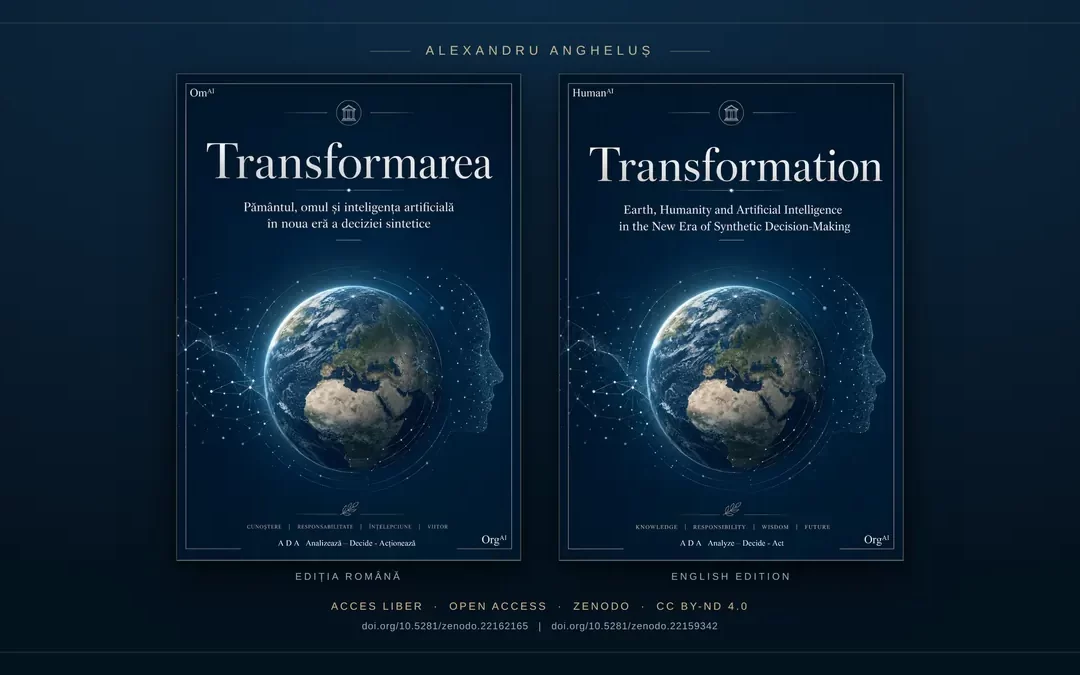
CyberAID announces the publication of “Transformation”, available in open access in both English and Romanian. The work continues the research direction of the ADA programme: Analyse, Decide, Act, and treats artificial intelligence not as one technological application among others, but as a cognitive layer positioned between people and reality. Three notations come out of it and are used here exactly as written: Humanᴬᴵ, Orgᴬᴵ and the cognitively assisted Earth.
The question the work starts from
Artificial intelligence filters information, generates content, recommends options, interprets complex environments and assists decisions, both individual and institutional. In that context, the question is no longer whether the technology will change the world. The question is whether that change will remain intelligible, governable and compatible with the material limits of the planet.
The analysis connects technology with human cognition, organisational transformation, cybersecurity, governance, geopolitics and the physical resources without which artificial intelligence infrastructures cannot operate.
Three working concepts
The cognitive layer and the cognitively assisted Earth
Artificial intelligence systems no longer work as isolated tools. Search engines decide which information reaches us first, recommendation systems shape choices, generative systems produce text, images, code and synthetic content, and decision-support platforms help organisations assess risk and allocate resources. As this mediation expands, artificial intelligence becomes part of the infrastructure through which reality is perceived and turned into action.
The work calls that state the cognitively assisted Earth. The term describes not only a technological system but also a physical one, because artificial intelligence is not immaterial. Its operation depends on:
- energy;
- water;
- computing infrastructure and data centres;
- semiconductors and critical minerals;
- telecommunications infrastructure;
- large volumes of data;
- specialised human labour.
The expansion of artificial intelligence is therefore also a material transformation, inseparable from energy availability, supply chain resilience and geopolitical competition for strategic resources.
Humanᴬᴵ, the artificially mediated human
The second concept, written Humanᴬᴵ, describes the individual whose capabilities, vulnerabilities and decision processes are increasingly mediated by artificial systems. Artificial intelligence can extend human capability considerably: it improves access to information, accelerates analysis, supports learning and assists decisions in complex environments.
At the same time, reliance introduces new vulnerabilities. When a person delegates information retrieval, interpretation or decision-making to an artificial system, their autonomy can either grow or shrink. The direction depends on three factors: competence, the degree of delegation and the mechanisms of verification. Someone who understands how the system works, can evaluate its output and independently verifies critical information uses artificial intelligence as an amplifier. Without those safeguards, the same technology produces dependency, cognitive outsourcing and the illusion of an informed decision.
Orgᴬᴵ, the artificially mediated organisation
The same transformation happens at organisational level, and the work writes it Orgᴬᴵ. Artificial intelligence is entering risk assessment, security operations, financial analysis, logistics, compliance, customer interaction and executive decision support. This changes not only organisational capability, but also the nature of organisational risk.
An organisation that delegates critical analytical or operational functions needs to know exactly what has been transferred to the machine and what remains under human control. The useful question is no longer whether the organisation uses artificial intelligence, but how much authority it has delegated, what controls surround those systems and how their output is verified.
Why this matters for cybersecurity education
For an educational programme, the most applicable observation in the work is that autonomy is rarely lost through a single decision. It erodes through an accumulation of small delegations, each one reasonable on its own. Three habits follow, which CyberAID treats as fundamental:
- know what you have delegated. Any task handed to an artificial system, from drafting to checking a source, should remain recognisable as such;
- keep a reserve competence. Being able to do manually, at least on a sample basis, what you normally automate is the only way to notice when the system is wrong;
- verify critical information independently. A convincingly generated answer is not a verified answer, and the difference matters most precisely when the decision is important.
The same three habits apply to organisations, at scale: an inventory of delegations, retained internal competence, and a procedure for verifying results.
Security in an environment populated by synthetic intelligence
The work also addresses the transformation of cybersecurity. Generative artificial intelligence changes defensive and offensive capabilities at the same time. It can help security teams detect anomalies, analyse large datasets and accelerate incident response, but it also supports better constructed phishing campaigns, automated social engineering, synthetic identities, deepfakes and disinformation operations at scale.
The conclusion is that cybersecurity extends beyond protecting systems and networks: it also means protecting the decision environment. When people and organisations work with machine-generated identities, content, arguments and evidence, establishing authenticity and provenance becomes a security function in its own right.
Governance and geopolitics
The work includes European Union and United States case studies, together with chapters on the governance of artificial intelligence and the strategic implications of access to computing infrastructure, energy, data and critical technological resources. The development of advanced systems cannot be analysed separately from technological sovereignty, semiconductor supply chains, energy infrastructure and strategic autonomy.
Rather than predicting a single future, the analysis explores several scenarios and focuses on the mechanisms that allow people and institutions to retain meaningful control while benefiting from increasingly capable systems.
The link with the ADA programme
“Transformation” continues the direction that previously produced the guide “Artificial Intelligence and the Manipulation of Human Perception”, which examined how synthetic content and automated persuasion mechanisms influence perception and decision-making. Where the guide dealt with the manipulation of information environments, this work widens the analysis to the broader transformation produced by artificial intelligence across individuals, organisations, infrastructure and society.
Access the work
The work is available in open access on Zenodo, under the Creative Commons Attribution No Derivatives 4.0 International licence (CC BY-ND 4.0). Author: Alexandru Ciprian Angheluș.
- English edition: zenodo.org/records/22159342, DOI 10.5281/zenodo.22159342;
- Romanian edition: zenodo.org/records/22162165, DOI 10.5281/zenodo.22162165.
The English edition is a full translation, with the same 32 graphical representations.
More on artificial intelligence
- The ADA guide: Artificial Intelligence and the Manipulation of Human Perception
- Deepfake and social engineering attacks
- Countering disinformation: critical thinking and information verification
- AI-generated visual content and its effect on children
- The Humanᴬᴵ and Orgᴬᴵ Framework Calculator, version 1.2.0